
25% of deceased ex-National Football League players had Chronic Traumatic Encephalopathy

A new BMJ study published on August 25 2026 and entitled Prevalence of chronic traumatic encephalopathy (CTE) at death in National Football League players: retrospective population based cohort study, 2008-21 BMJ 2026; 394 doi: https://doi.org/10.1136/bmj-2026-100418 found that about 25% of former NFL players who died from 2016 to 2021 had CTE, underscoring football’s ongoing head-trauma risks.
Head trauma has increasingly become an existential question for football. But just how common brain damage is among players was an open question until Tuesday, when an alarm published in BMJ found that one quarter of former NFL players who died over a recent six-year period had the neurodegenerative disease known as CTE or Chronic Traumatic Encephalopathy. The study was analysed in the Boston Globe by By Allyson Chiu and Matt Porter, both part of the Globe Staff, on Aug. 25, 2026
We summarize their article
Researchers said the true rate may be higher because the estimate is based only on donated brains. The research, led by Mass General Brigham, Boston University, and the Concussion & CTE Foundation, raises safety concerns from youth football through the NFL. Lead author Dr. Daniel Daneshvar said "They got exposed to head impacts at the collegiate level, at the high school level, and in many cases, the youth level. All of those hits accumulated to increase their risk of having this pathology in their brain.”He called the findings a “wake-up call.” CTE affects less than 1% of the general population, but the study suggests at least 13 players on a 53-man NFL roster could develop it. Daneshvar said the findings show the need to treat and ultimately cure CTE. Unlike earlier brain-bank studies, this one estimates CTE prevalence across the broader NFL population.
The NFL Players Association called the study a “sobering reminder” and a “call to action.” The union urged more research, better care, improved treatments, and stronger support for affected players. The NFL requires most players to wear Guardian caps during contact practices unless they use approved high-performance helmets. Boston’s Patriots receiver DeMario Douglas said he relies on a newer helmet rather than a Guardian cap. He said the newer model felt safer after hard hits. Patriots lineman Greg Van Roten also praised newer helmets and Guardian caps. He said modern helmets feel safest, with Guardian caps adding another layer of protection. Football’s long-term risks remain clear: several members of the 2001 Patriots died young, and former players including Junior Seau and Aaron Hernandez were later found to have CTE.
The NFL began removing players with suspected head trauma in 2009, after years of resisting CTE research, and later settled a former players’ concussion lawsuit for $1 billion. The league said it remains committed to reducing concussions and head impacts. At the high school level, some Massachusetts teams limit contact in practice to reduce head trauma. Milton High coach Steve Dembowski said his team avoids live tackling, though compliance varies across programs.
CTE is a progressive brain disease linked to repeated head impacts. It is most associated with football, but also affects athletes in hockey, rugby, soccer, MMA and some military personnel. Symptoms may include memory loss, cognitive decline, and severe behavior or mood changes. CTE can only be definitively diagnosed after death through brain-tissue analysis.
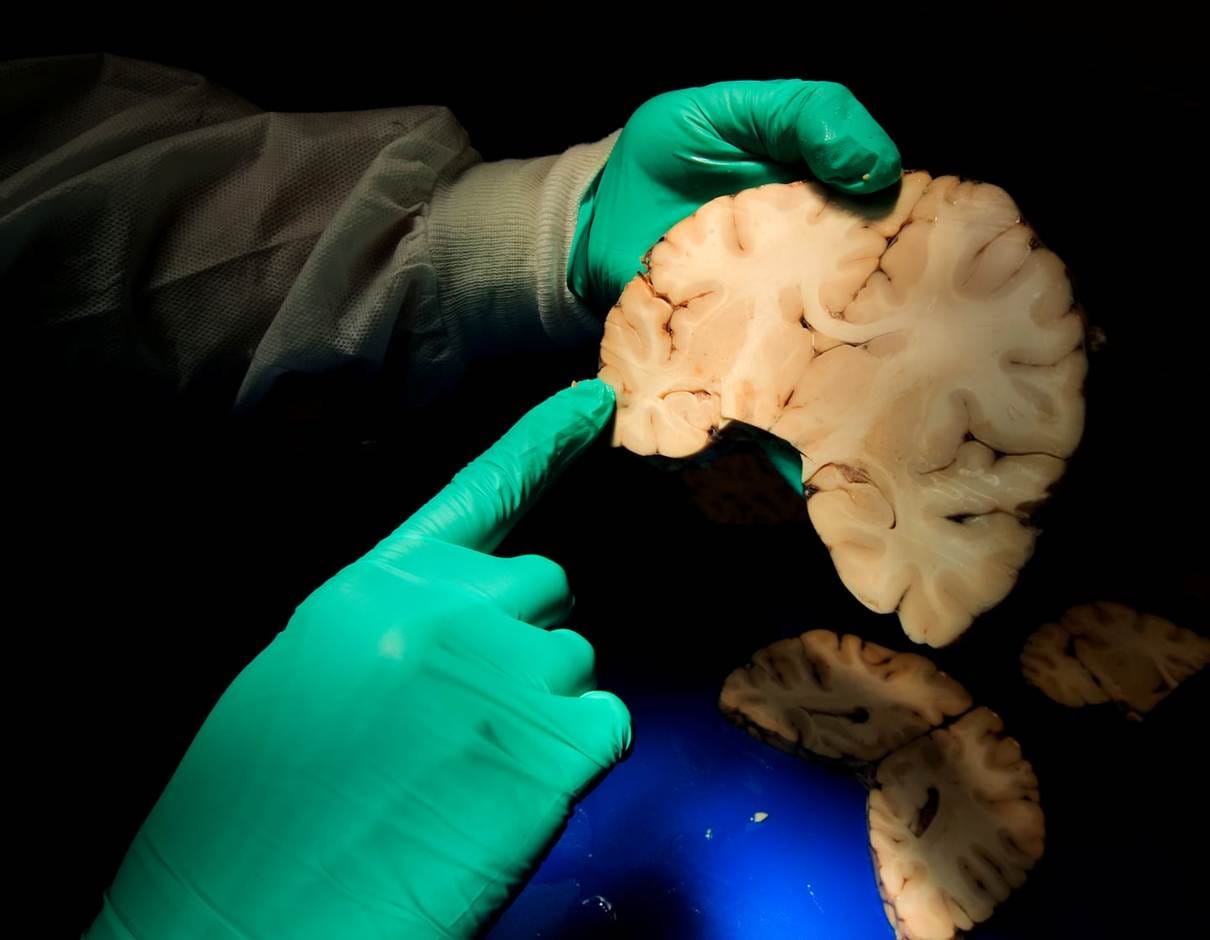
Dr. Ann McKee, director of BU’s CTE Center and chief of Neuropathology at the VA Boston Healthcare System, analyzed brain tissue in Jamaica Plain.
The study reviewed more than 1,700 NFL players who died between 2008 and 2021, focusing on 2016-2021, when brain donations were more common. Among 878 former players who died from 2016 to 2021, 235 donated their brains and 215 were found to have CTE, producing the study’s 25% estimate. Researchers said the true prevalence is likely higher because many brains were not donated. About 60% of diagnosed CTE cases also involved dementia and severe impairment.
Daneshvar said cumulative hits over years of play are the main CTE risk driver. He urged youth, high school, and college programs to follow NFL limits on full-contact practices. He said that could cut head impacts by more than 60% and lower later neurodegenerative risk. Some players are also using newer helmets and padded caps to reduce impacts. Guardian Sports CEO Erin Hanson said players must reduce all head impacts, not only concussions. Still, Hanson said equipment is only one part of prevention. She added that no helmet or equipment can prevent or treat CTE.
Starting in 2024, players had the option to wear them in games, but few do. Two Patriots — offensive lineman Jared Wilson and wide receiver Romeo Doubs — are among them.
“You can get ankle replacements, shoulder replacements, knee replacements. You can’t replace your brain, Jared Wilson said.
La Baule, August 26, 2026.
Comments ()