
Radioligand therapies: a rapidly evolving radiopharmaceutical field
Radiopharmaceuticals emerged from more than a century of collaboration among chemists, physicists and physicians. In 1913, Hungarian scientist George de Hevesy established the radiotracer principle: a tiny quantity of a radioactive isotope can track a biological process without changing its function. In 1925, Herman Ludwig Blumgart and Soma Weiss used bismuth-214 in humans to measure blood transit time between the arms. In 1936, John Lawrence used cyclotron-produced phosphorus-32 (³²P) to treat leukaemia and blood disorders. In 1942, Saul Hertz and Samuel Seidlin used radioactive iodine to treat hyperthyroidism. In 1951, sodium iodide (¹³¹I) became the first radiopharmaceutical approved by the US FDA. The imaging boom of the 1960s–1980s paved the way for modern radioimmunotherapy and theragnostic.
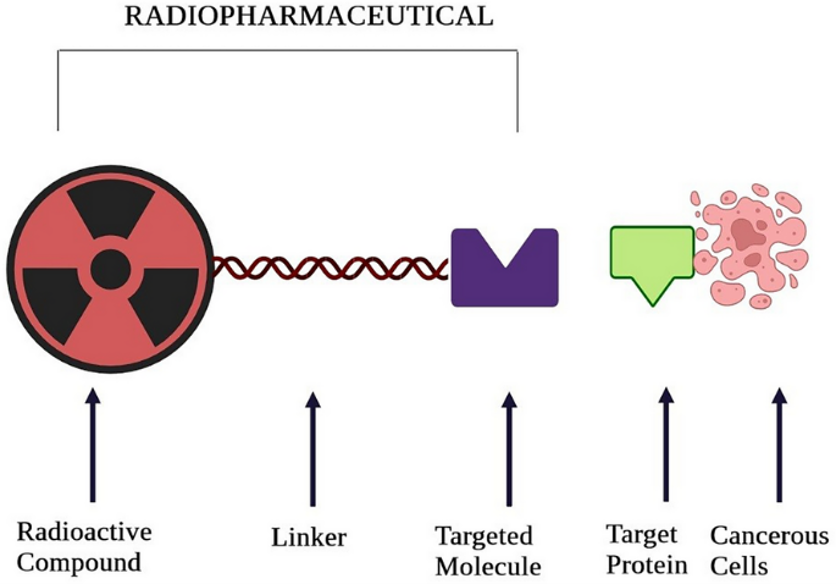
This note focuses on a small part of the radiopharmaceutical field used in diagnosis and cancer treatment: radioligand therapies (RLTs). These complex molecules combine three elements—a targeting component, a linker and a radioactive payload, or radionuclide.
The radionuclide is an unstable isotope chosen for its radiation characteristics and short half-life. Common examples include lutetium-177 (¹⁷⁷Lu) and actinium-225 (²²⁵Ac). The linker connects the radioactive payload to the targeting component and keeps the construct stable in the bloodstream. The targeting component—an antibody, peptide or small molecule—binds selectively to overexpressed cell-surface receptors or specific antigens. Each complex molecular construct (see schemes and attached video) is designed to bind to specific receptors expressed on the surface of a certain type of tumours. Its purpose is to deliver the radionuclide to the intended cells, where alpha or beta radiation damages their DNA.
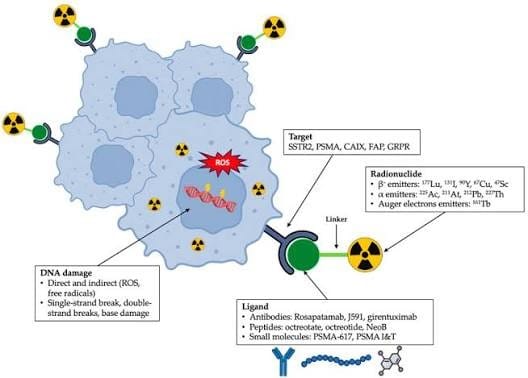
Unlike conventional chemotherapy or external radiotherapy, RLTs aim to concentrate radiation in tumours while limiting exposure to healthy tissue. Their design resembles that of antibody–drug conjugates (ADCs), and their path to success has been similarly challenging.
Early adopters’ setbacks
IDEC Pharmaceuticals developed Zevalin (ibritumomab tiuxetan) for non-Hodgkin lymphoma. It combined an anti-CD20 antibody with yttrium-90 to deliver radiation directly to malignant B cells. On February 19, 2002, the FDA approved it for relapsed or refractory CD20-positive B-cell non-Hodgkin lymphoma, making it the first approved radioimmunotherapy. It was also approved for diagnostic purposes in using indium-111 imaging before yttrium-90 treatment. Despite its scientific promise, sales were initially low and subsequently declined.
Corixa’s Bexxar combined the anti-CD20 antibody tositumomab with iodine-131 to irradiate malignant B cells in certain non-Hodgkin lymphomas. The FDA approved it on June 27, 2003, for the same indication as Zevalin. In late 2004, GSK acquired worldwide rights and responsibility for its manufacture, development and commercialisation.
Many oncologists considered Zevalin and Bexxar effective, with the potential for long remissions. However, treatment required coordination between oncology and nuclear-medicine teams, alongside special radioactive-material handling. Complex reimbursement, high costs, manufacturing and regulatory difficulties, as well as limited physician adoption constrained sales. GSK stopped manufacturing Bexxar in 2014. Both products illustrate how clinically useful innovation can struggle commercially when adoption, economics and operational requirements do not align.
In 2016, French specialty pharmaceutical company Ipsen acquired a neurotensin-receptor-targeting RLT for pancreatic adenocarcinoma from Germany’s 3B Pharmaceuticals. The candidate, IPN-1087, was sold to Canada’s Fusion Pharmaceuticals in April 2021.
The first commercial success
Despite these setbacks, Novartis acquired US-based Endocyte’s radioligand platform on December 21, 2018, for $2.1 billion, with Pluvicto as its most advanced asset. Pluvicto (lutetium Lu-177 vipivotide tetraxetan) combines Lu-177 held within a macrocyclic ring with a high-affinity, urea-based peptidomimetic that binds prostate-specific membrane antigen (PSMA), connected through a hydrophobic linker. Phase III results announced on March 23, 2021, showed a 38% reduction in the risk of death and a 60% reduction in the risk of progression or death. The FDA approved it on March 22, 2022, for metastatic castration-resistant prostate cancer. Strong oncologist acceptance did not prevent launch difficulties. In early 2023, Novartis temporarily stopped accepting new patients amid waiting lists lasting several months. Lu-177 has a half-life of 6.647 days, requiring each batch to reach patients within five days or be discarded. At launch, a single facility in Ivrea, Italy, supplied the global market, and production problems or shipping delays cancelled numerous appointments. Lu-177 production was also vulnerable to fluctuations in global nuclear infrastructure. Nevertheless, Novartis built a strong growth platform, with 2026 sales projected to exceed $2.5 billion. It has repeatedly framed RLT as one of its defining capabilities, alongside cell and gene therapy and RNA therapeutics. To better secure its supply, Novartis announced the expansion of a new RTL manufacturing facility in Winter Park, Florida in January 2026 as part of a $23 billion investment in the US. As a reminder it is useful to note that the Swiss company had already received approval in 2018 for Lutathera (lutetium Lu-177 dotatate) to treat somatostatin-receptor-positive gastroenteropancreatic neuroendocrine tumours.
Recent industry transactions
In June 2021, Bayer, already marketing Xofigo (radium-223 dichloride) for advanced prostate cancer, acquired Noria Therapeutics and its differentiated actinium-225-labelled, PSMA-targeting small molecule. In August 2021, Germany’s Merck KGaA and Australia’s Telix Pharmaceuticals began a collaboration to study one of Merck’s molecules in combination with Telix’s TLX591 (Lu-177 rosopatamab) and TLX250 (Lu 177 girentuximab).
Pluvicto’s success sparked renewed interest in RLTs and opened new growth opportunities.
In October 2023, Eli Lilly announced its $1.4 billion acquisition of US-based Point Biopharma and its radiopharmaceutical portfolio. Lilly described the deal as the start of its investment in multiple radioligand medicines for hard-to-treat cancers. The most advanced asset is described as structurally similar to Pluvicto.
In February 2024, Bristol Myers Squibb acquired US-based RayzeBio for $4.1 billion, adding a differentiated actinium-based radiopharmaceutical platform to its oncology pipeline.
In May 2024, Novartis acquired US-based Mariana Oncology for $1 billion, with a further $750 million in payments, to strengthen its RLT pipeline.
In June 2024, AstraZeneca entered the field through its acquisition of Canada’s Fusion Pharmaceuticals in a deal worth $2.4 billion.
In late 2023, Roche agreed to work with Japan’s PeptiDream on macrocyclic peptide–radioligand conjugates. In May 2025, Korea’s CellBion announced a clinical-trial collaboration and supply agreement with Merck & Co. to evaluate its PSMA-targeting radioligand, lutetium Lu-177 DGUL, alongside MSD’s anti-PD-1 therapy Keytruda in advanced prostate cancer.
Further notable agreements between pharmaceutical companies and radiopharmaceutical specialists were announced in 2026:
In April 2026, Regeneron and Telix Pharmaceuticals announced a strategic collaboration to co-develop and commercialise next-generation RLTs.
On September 21, 2026, Telix Pharmaceuticals announced its acquisition of ITM Isotope Technologies based in Munich for $1.65 billion upfront. The deal adds ITM’s radiopharmaceutical supply network and an R&D pipeline led by ITM-11, a potential competitor to Novartis’s Lutathera.
Operational challenges
RLTs are difficult to use because they involve highly radioactive materials with lifetimes ranging from hours to days. Unlike conventional medicines and diagnostics, they require dedicated supply chains and nuclear-medicine teams. Effective treatment depends on radionuclides that rapidly deliver high-energy radiation to damage cancer-cell DNA, with short half-lives intended to limit the duration of active radiation. Medical isotopes such as F-18, Ga-68, Tc-99m, Y-90, I-131, Lu-177 and Ac-225 serve diagnostic or therapeutic purposes. The distinction lies in the type and amount of radiation emitted: therapeutic radiopharmaceuticals generally deliver higher doses over longer periods. F-18 and Ga-68 have half-lives of 1.83 and 1.13 hours, respectively, compared with 2.67 days for Y-90, 6.65 days for Lu-177, 8.02 days for I-131 and 9.92 days for Ac-225. The most used Lu-177 and Ac-225 act primarily as beta-minus (β⁻) emitters, with low-energy gamma (γ) rays useful for imaging.
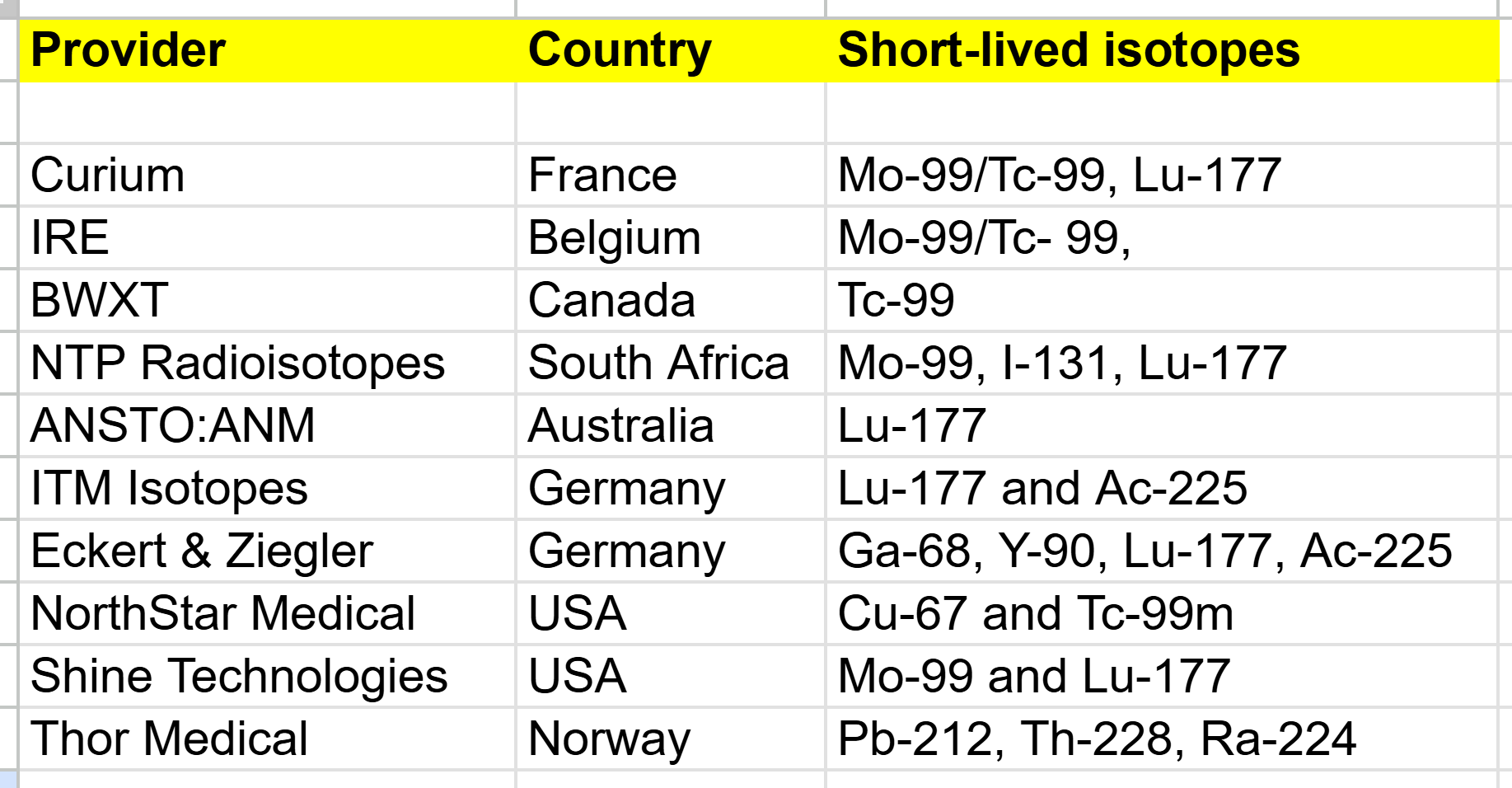
A limited number of companies produce these short-lived radionuclides using a small network of reactors, accelerators, generators and cyclotrons, supplying the radiopharmaceutical industry. As the accompanying list shows, most leading suppliers are based in Europe.
Conclusion
As often happens with breakthrough technologies, RLT pioneers were less successful than fast followers better equipped to manage innovation’s unexpected hurdles. Novartis’s clinical and commercial success with Pluvicto in resistant prostate cancer prompted major oncology companies to add RLTs to their pipelines. Yet manufacturing, supplying and handling these short-lived radioactive constructs will remain complex, limiting widespread use. European companies currently lead the supply of suitable radionuclides. Optimists envisage RLTs gradually replacing conventional radiotherapy by reliably delivering well-defined radiation to specific cancers while protecting surrounding tissue. For the foreseeable future, however, RLTs are more likely to follow the ADC model: another valuable option within the oncologist’s expanding treatment arsenal.
A modified version of this article will appear in the November-December issue of MedNous
Paris, November 9, 2026
This document has been prepared by Jean-Claude Muller and is provided for information purposes only. The information contained herein has been obtained from sources believed to be reliable but is not warranted to be accurate or complete. The views presented are those of the author at the time of writing and are subject to change. Jean-Claude Muller has no obligation to update these opinions or the information presented.



Comments ()